
Generative AI (GenAI) makes prototyping ridiculously fast. NT Concepts historically builds everything from scratch, every line of code methodically crafted by trusted developers.
A new phenomenon has emerged with the exponentially fast evolution of GenAI coding agents like Google Gemini 3.0, Claude 4.6+ Opus, OpenAI ChatGPT 5.3 Codex, and others that outperform traditional software engineers in speed and functionality.
The hard part is building something useful that can survive real users, real data sensitivity, and real governance. I’ve developed a repeatable process for taking those “Vibe Coded” application prototypes and maturing or rewriting securely for production: prototype fast → promote deliberately → harden with security-by-design → scale across JWCC cloud options.
The problem: speed is cheap, trust is expensive
In the military and intelligence space, we don’t struggle with ideas. We struggle with maturing ideas into capabilities that can handle:
- mission pressure
- sensitive data
- adversarial behavior
- compliance and operational guardrails
GenAI compresses the “idea-to-demo” timeline. But it also makes it easy to ship a fragile prototype with invisible risk: hardcoded secrets, unclear boundaries, ambiguous logging, and “we’ll secure it later.” That “later” is where prototypes go to die.
The “so what”: GenAI is the accelerator, not the mission
GenAI’s value isn’t “chatbots.” It’s the ability to move faster through the decision-action loop (e.g. OODA) that actually matters:
- Faster iteration with warfighters (days, not quarters)
- Knowledge-grounded assistants (RAG over doctrine, TTPs, tech manuals, SOPs, intel products)
- Workflow automation with control (agents that act, but only within strict permissions and audit)
- Training at scale (scenario-driven learning that doesn’t require an instructor for every repetition)
The approach: prototype fast, then “promote” like you mean it
Treat prototypes like a separate species from fieldable software. They’re useful, but they need a promotion path.
- Export/clone into a real repo
- Minimal
README(run steps, core user flows, assumptions) - Decide what kind of data is allowed (public vs CUI/PII/mission)
Before scaling anything:
- threat model (what breaks, who attacks, what gets exposed)
- boundaries (what the app will never do)
- identity model (who can do what)
- logging/audit strategy
- deployment strategy (dev/test/prod separation from day one)
- Lane A: Fast reset + iterate (when you’re still shaping the idea)
- Lane B: Repo-based promotion (branches, CI/CD, test gates, deployment discipline)
- Lane C: Agent-assisted dev with rules (diff control, review gates, “no surprise refactors”)
- Lane D: DoD/DoW Authority to Operate (ATO) or Interim ATO (IATO) and eMASS (Enterprise Mission Assurance Support Service) packet for production applications
Non-negotiable rule: If the app is touching sensitive data or mission networks, you don’t “prototype your way into prod.” You promote intentionally.
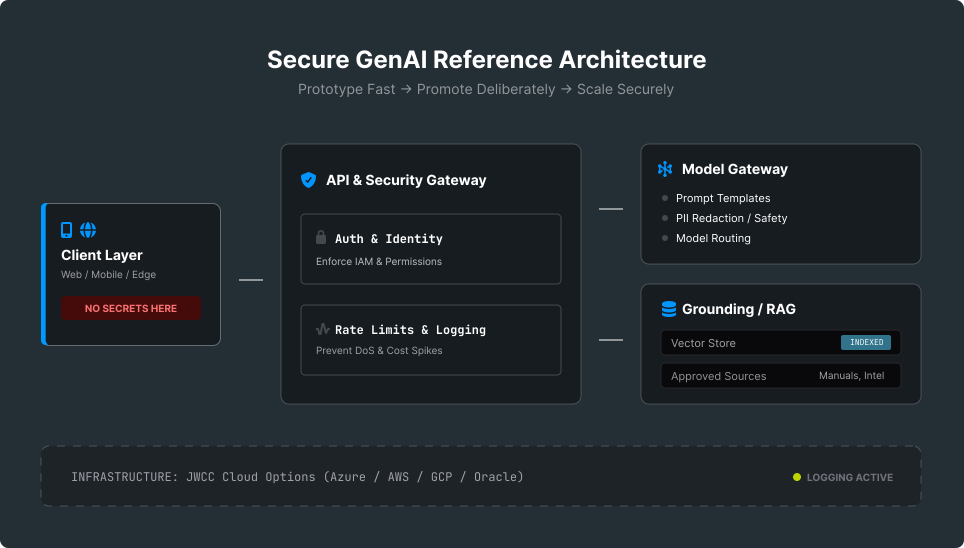
Reference architecture (cloud-agnostic, JWCC-ready)
Keep the baseline simple and defensible across vendors:
- Client (web/mobile): No secrets in the client. Ever. If the UI needs a key, you already lost.
- API layer: Enforces auth, rate limits, logging, and tool access (what the model can and cannot call).
- Model gateway: Central policy: allowed models, prompt templates, safety filters, redaction rules.
- Grounding / RAG: Approved sources → chunking → embeddings → vector store → citations + evaluation.
- Telemetry + audit: Prompt metadata, tool calls, user actions. Retention policy decided upfront.
- CI/CD + IaC: Reproducible builds, artifact provenance, SBOMs, gated releases.
This stack works in Azure, AWS, Google, and Oracle. The difference is how fast you can integrate identity, controls, and managed AI services in your environment.
JWCC Cloud AoA (practical, not marketing)
Comparison scope:
- GenAI services: model access + managed orchestration
- RAG options: native KB features vs “build your own”
- Safety & guardrails: injection defense, PII controls, policy enforcement
- Integration friction: identity, secrets, logging, networking
- Time-to-prototype vs time-to-launch-ready
- Skills required
| Area | Microsoft Azure | AWS | Google Cloud | Oracle Cloud (OCI) |
|---|---|---|---|---|
| GenAI platform | Azure OpenAI + Azure AI services | Amazon Bedrock | Vertex AI (Gemini + ecosystem) | OCI Generative AI |
| Managed “agent” pattern | Strong enterprise tooling ecosystem | Bedrock Agents + KB patterns | Vertex app/agent patterns | OCI Generative AI Agents |
| RAG / knowledge | Azure AI Search is a common backbone | Bedrock Knowledge Bases | Vertex AI grounding/RAG patterns | OCI retrieval + embedding tooling |
| Safety / guardrails | Azure content safety + policy controls | Bedrock Guardrails | Model Armor-style protections | OCI guardrails + policy controls |
| Identity integration | Best-in-class for Entra-heavy orgs | Very strong IAM, can be policy-heavy | Solid, depends on enterprise footprint | Strong tenancy isolation model |
| Observability | Mature enterprise monitoring suite | Mature cloud-native monitoring suite | Strong monitoring/logging suite | Strong OCI logging/monitoring |
| Prototype time | 3–10 days | 3–10 days | 3–10 days | 4–14 days |
| “Launch-ready” time | +2–4 weeks | +2–4 weeks | +2–5 weeks | +3–6 weeks |
| Skills needed | App dev + EntraID + CI/CD + AI/RAG | App dev + IAM policies + CI/CD + AI/RAG | App dev + IAM + AI/RAG + compliance scope | App dev + OCI IAM/networking + AI/RAG |
| Best fit when… | You live in M365/EntraID and need tight integration | You want breadth of models + mature cloud patterns | You want unified AI platform workflows | You want OCI’s defense posture and tenancy isolation |
Reality check: Platform choice matters less than whether you’ve built a promotion pipeline that produces evidence: controls, logs, boundaries, test results, and operational plans.
The maturation goal: Warfighter value + enterprise survivability
Build your Agentic AI foundation and tailored Commercial Solution Offering (CSO) with the end in mind:
- operationally useful
- constrained by design
- auditable
- deployable on JWCC-aligned cloud options
- promotable from demo → production without rewriting everything
